New York, US
Spotify UX Concept Design: Spotify Vinyl
“Spotify Vinyl” is a product design concept that translates the physical behavior of vinyl digging into an intuitive music-discovery experience.
Industry
Entertainment
Client
Personal Project
Team
Personal Project
Role
Product Designer
Timeline
January, 2026 (2 weeks)
Category
App Design
Artificial Intelligence
Spotify UX Concept Design: Spotify Vinyl
“Spotify Vinyl” is a product design concept that translates the physical behavior of vinyl digging into an intuitive music-discovery experience.
Industry
Entertainment
Client
Personal Project
Team
Personal Project
Role
Product Designer
Timeline
January, 2026 (2 weeks)
Category
App Design
Artificial Intelligence
Spotify UX Concept Design: Spotify Vinyl
“Spotify Vinyl” is a product design concept that translates the physical behavior of vinyl digging into an intuitive music-discovery experience.
Industry
Entertainment
Client
Personal Project
Team
Personal Project
Role
Product Designer
Timeline
January, 2026 (2 weeks)
Category
App Design
Artificial Intelligence
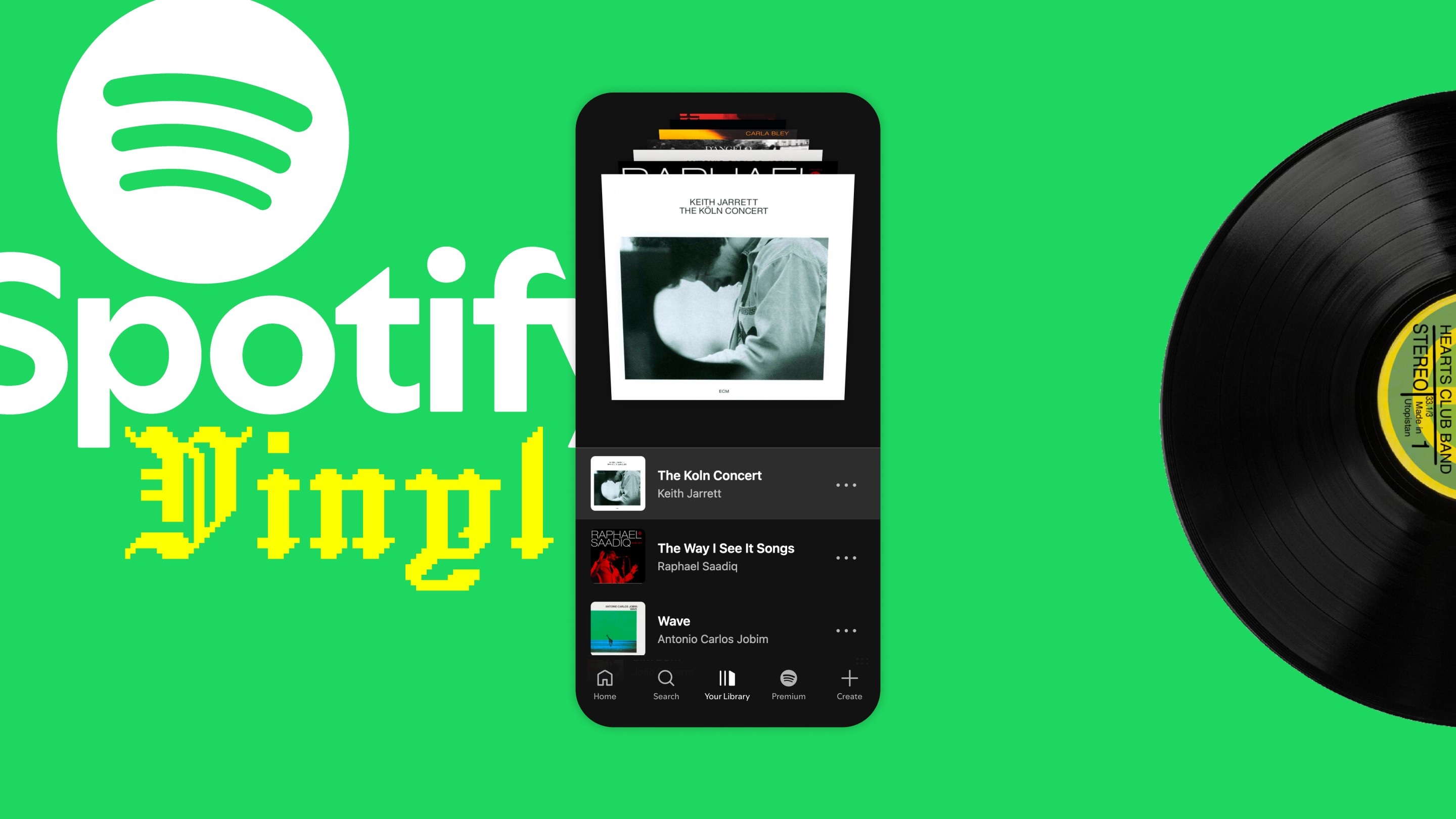
After spending long hours in record shops, I experienced a clear friction point: discovering music from physical album covers required separate image searches and disconnected tools. This project reimagines Spotify’s camera feature by introducing a seamless album cover-scanning flow and creating a new UX interaction for searched album covers.
By integrating an AI agent directly into the workflow, the entire system, from concept to fully functioning prototype, was built using various AI tools, including Claude Sonet 4.5 / Chat GPT / Figma Make.
After spending long hours in record shops, I experienced a clear friction point: discovering music from physical album covers required separate image searches and disconnected tools. This project reimagines Spotify’s camera feature by introducing a seamless album cover-scanning flow and creating a new UX interaction for searched album covers.
By integrating an AI agent directly into the workflow, the entire system, from concept to fully functioning prototype, was built using various AI tools, including Claude Sonet 4.5 / Chat GPT / Figma Make.
Introduction
Introduction
Music Streaming Platform is all about music curation.
Music Streaming Platform is all about music curation.
There are tons of different ways to explore new music. For people with cool friends, social features like “what music my friends listen to” make discovery effortless, or you can simply let Spotify do everything for you with its powerful curation algorithm. But if you love collecting and still remember the texture of music, here’s a new way to explore your music on Spotify.
There are tons of different ways to explore new music. For people with cool friends, social features like “what music my friends listen to” make discovery effortless, or you can simply let Spotify do everything for you with its powerful curation algorithm.
But if you love collecting and still remember the texture of music, here’s a new way to explore your music on Spotify.
User Pain point
User Pain point
Physical → Digital Music Exploration Journey
Physical → Digital Music Exploration Journey
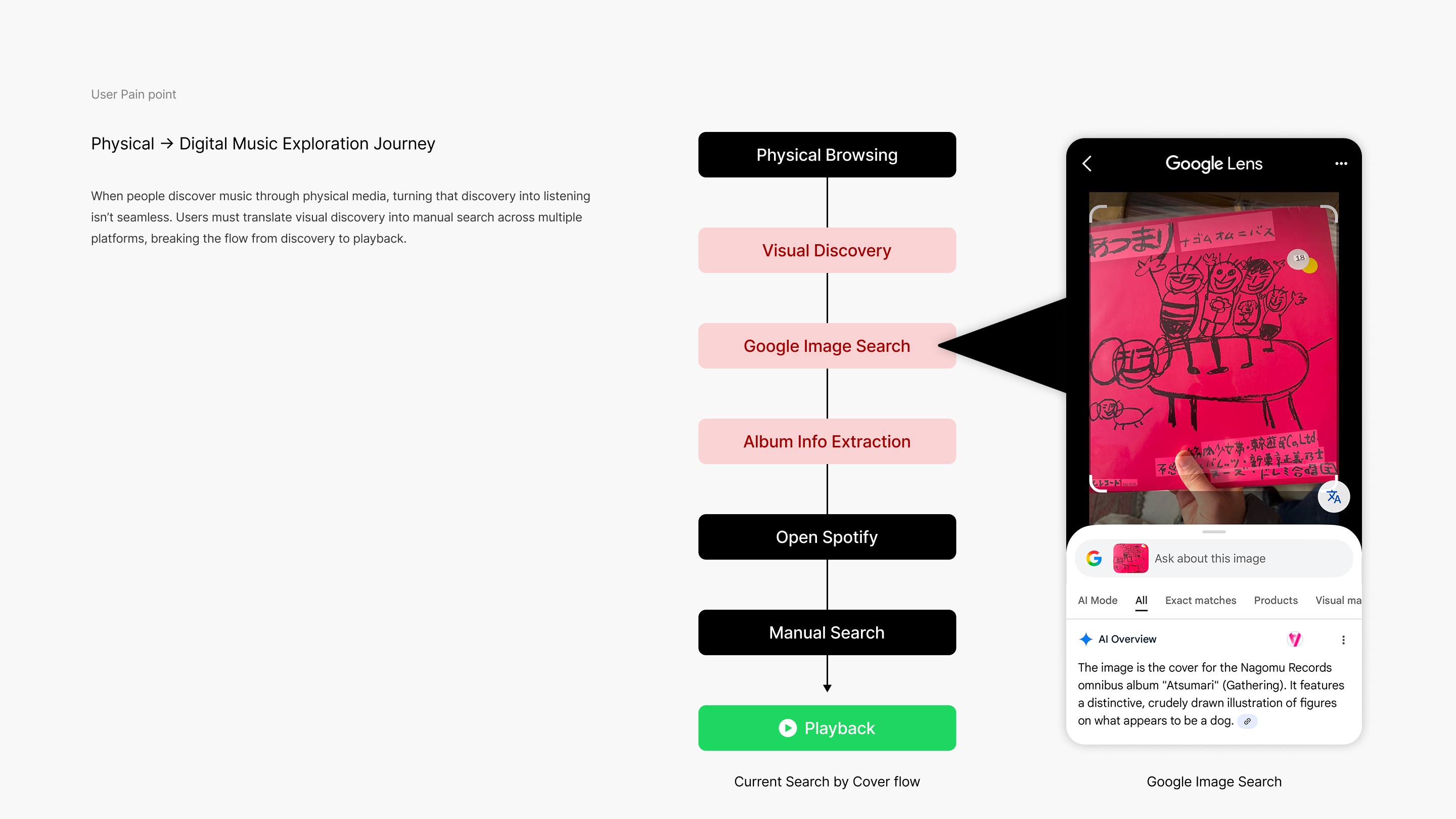
When people discover music through physical media, turning that discovery into listening isn’t seamless. Users must translate visual discovery into manual search across multiple platforms, breaking the flow from discovery to playback.
When people discover music through physical media, turning that discovery into listening isn’t seamless. Users must translate visual discovery into manual search across multiple platforms, breaking the flow from discovery to playback.
Solution / Visual Search
Solution / Visual Search
Spotify’s Native Visual Scanning for Instant Playback
Spotify’s Native Visual Scanning for Instant Playback
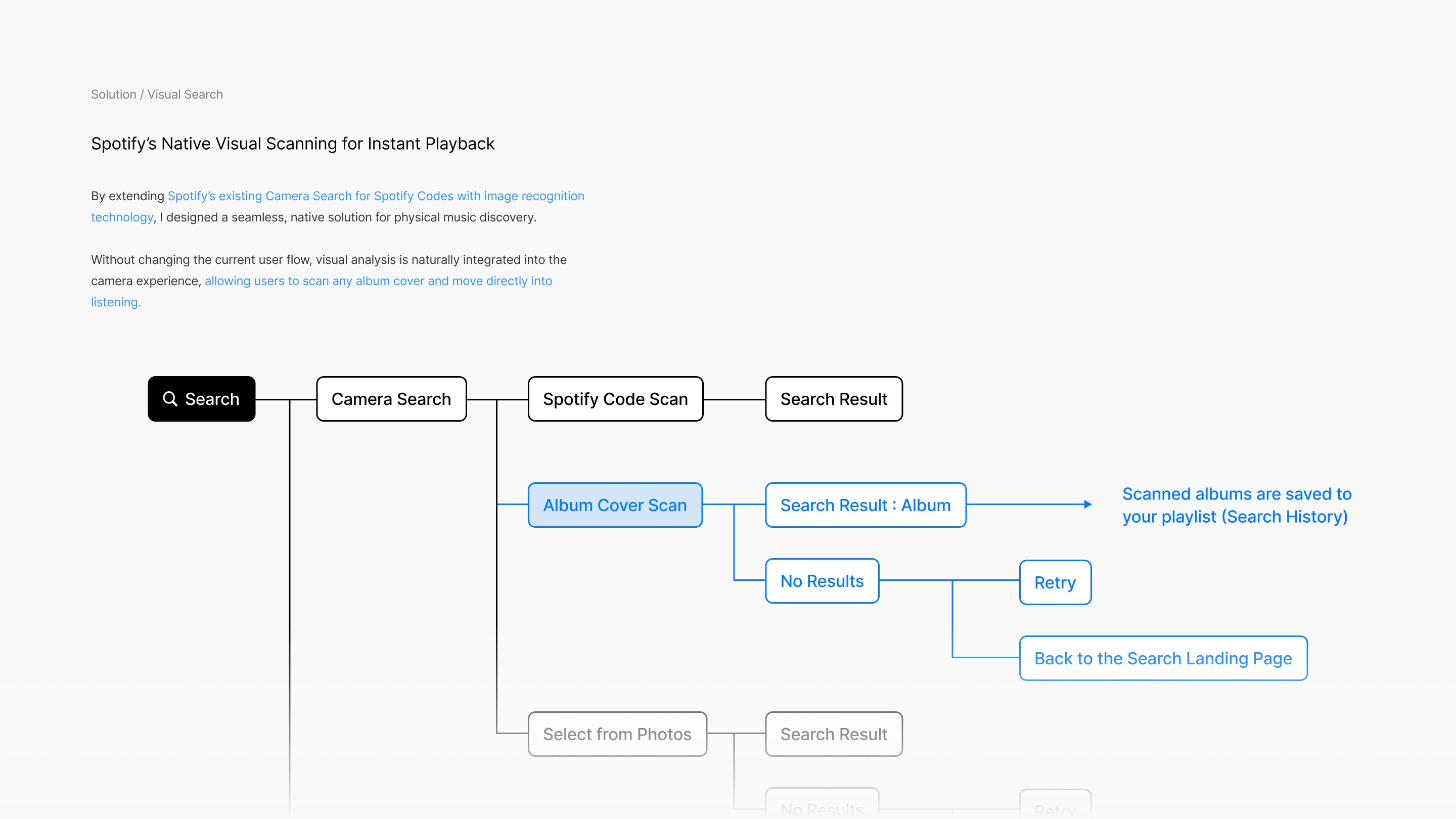
By extending Spotify’s existing Camera Search for Spotify Codes with image recognition technology, I designed a seamless, native solution for physical music discovery. Without changing the current user flow, visual analysis is naturally integrated into the camera experience, allowing users to scan any album cover and move directly into listening.
By extending Spotify’s existing Camera Search for Spotify Codes with image recognition technology, I designed a seamless, native solution for physical music discovery. Without changing the current user flow, visual analysis is naturally integrated into the camera experience, allowing users to scan any album cover and move directly into listening.
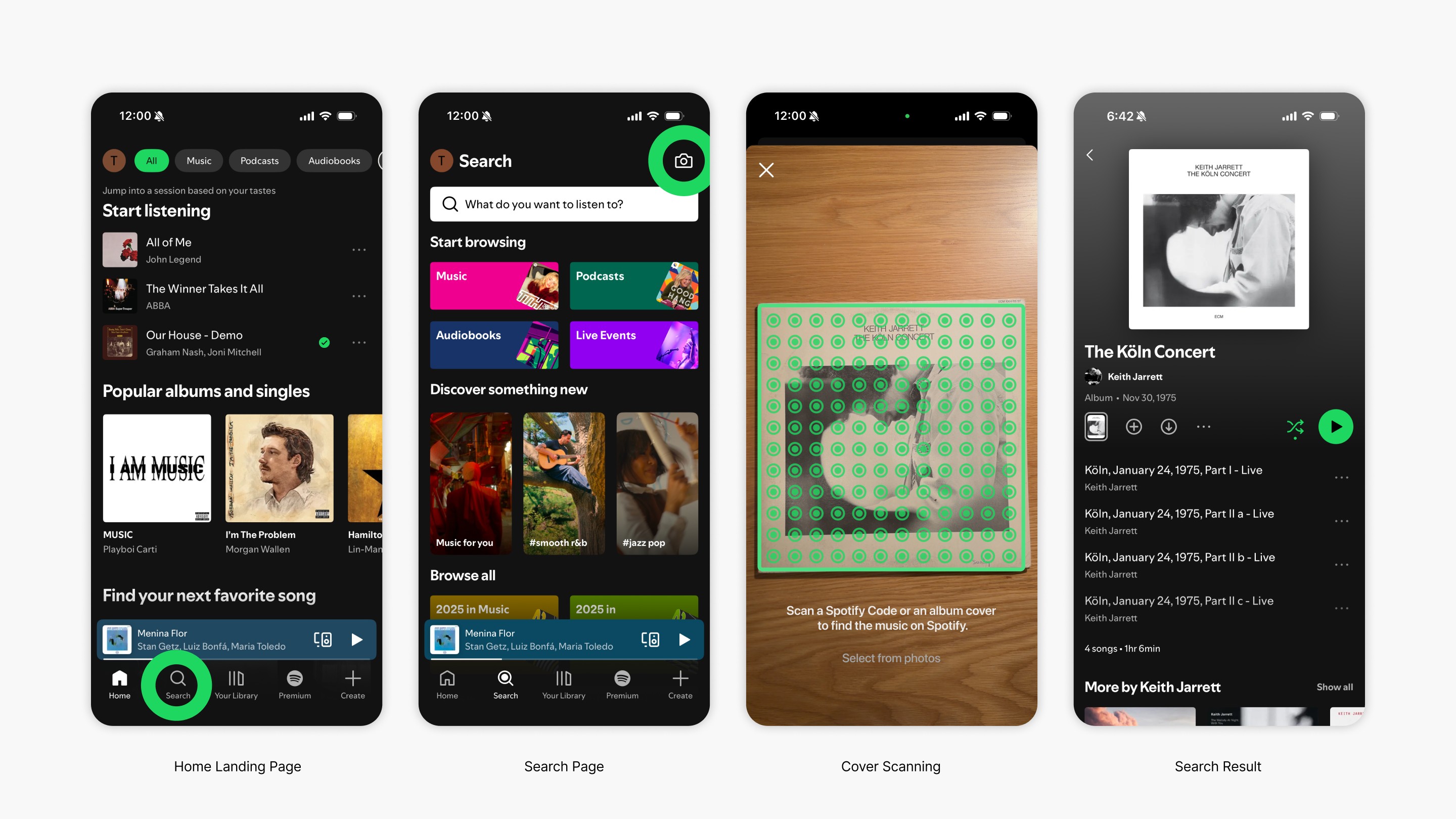
Figma Prototype / Album Cover Search Flow
Solution / Search History
Solution / Search History
Human-Centered Vinyl Exploration Interaction (Search History)
Human-Centered Vinyl Exploration Interaction (Search History)
Albums searched through the camera are saved into a playlist, designed with interactions that mimic the natural hand gesture of flipping through records. This experience-centered interaction brings that physical behavior into the digital space, creating an intuitive, natural bridge between physical and digital music discovery.
Albums searched through the camera are saved into a playlist, designed with interactions that mimic the natural hand gesture of flipping through records. This experience-centered interaction brings that physical behavior into the digital space, creating an intuitive, natural bridge between physical and digital music discovery.
JavaScript React Prototype (Click to try)
JavaScript React Prototype (Click to try)
Final Design
Final Design
Turning everyday problems into real, working products — with AI-driven workflows.
Turning everyday problems into real, working products — with AI-driven workflows.
By embedding AI deeply into my design and development workflow, I was able to translate real-life friction into structured UX problems, systemized solutions, and fully functioning prototypes in a rapid and iterative way.
(AI Integration) This workflow was supported by Claude Sonnet 4.5 and ChatGPT, used for ideation, UX logic modeling, system architecture, code structuring, and rapid validation — enabling fast execution without sacrificing design quality.
By embedding AI deeply into my design and development workflow, I was able to translate real-life friction into structured UX problems, systemized solutions, and fully functioning prototypes in a rapid and iterative way.
(AI Integration) This workflow was supported by Claude Sonnet 4.5 and ChatGPT, used for ideation, UX logic modeling, system architecture, code structuring, and rapid validation — enabling fast execution without sacrificing design quality.